
Aerobic – Metabolic Analysis
Let’s start by sharing some key information to help you understand what matters most. Take a look at the details below. Effective cardio training begins with knowing the right figures, and we strongly suggest clicking the button below to let us calculate them for you—at no cost!
Let us do the calculations for you.
It’s best not to pick some numbers out of thin air.
Estimated Max Aerobic Threshold (AT)
Knowing your aerobic threshold (AT) is an essential number that allows you to plan properly and engage in Zone 2 training, also known as steady-state training, which should constitute approximately 80% of your aerobic training volume. This calculated or estimated beats per minute (bpm) value, where your body transitions from Zone 2 (aerobic, using oxygen pathways) to Zone 3 (anaerobic, using non-oxygen pathways), can be determined using the MAF formula and is crucial for conducting proper Zone 2 training by keeping your heart rate below this number during sessions. While not glamorous, Zone 2 training provides the biggest bang for improving health, performance, and endurance, optimizing fat oxidation (burning the most fat), increasing capillary density and mitochondria, benefiting muscular fitness, and lowering resting heart rate while boosting aerobic capacity—guaranteed results without question. The AT calculation may vary in accuracy depending on an individual’s physical conditioning and other factors, but it serves as an essential starting point; working 1-on-1 with a Point1 expert using various devices and software offers the most precise estimate outside a lab setting, though the number in this initial analysis is the best to begin with. At Zone 3 and above, the body shifts to anaerobic pathways, accumulating lactic acid in tissues (the infamous “burn”) and triggering other physiological changes. Developing a robust Zone 2 plan, which accounts for your unique aerobic fitness level, ensures increased endurance and overall performance, so stop wasting time with ineffective or damaging cardio and incorporate these techniques into your regimen. Don’t wait—engage with Point1 to learn how to calculate this number more accurately and maximize your health and efforts today, with guaranteed improvements to your health, performance, and endurance. In the meantime, read the rest of this report for more insights.
Estimated Daily Metabolic Rate
Your Daily Metabolic Rate (DMR), also known as your Active Metabolic Rate (AMR), is an extension of your Basal Metabolic Rate (BMR), which is the amount of energy (kcal – calories) your body expends at rest. DMR incorporates your daily activity level to estimate the increased calorie expenditure needed to offset your activity, providing a more accurate assessment than AMR alone of what your daily caloric intake should be to maintain your current weight. With this knowledge, and even greater precision through the use of electronics, devices, and apps to track calorie expenditure from sports and activities, Point1 can help you perform a full assessment and develop a robust plan to achieve your specific body composition goals—whether losing excess weight by maintaining the stated activity level while eating at a calorie deficit, or gaining desired weight and muscle mass (with appropriate training) by consuming calories in excess of this number. Knowing your DMR is crucial if you’re serious about your goals, and Point1 guarantees a tailored, detailed plan to guide you toward greatness in weight management and body composition.
Maximum Heart Rate (MaxHR)
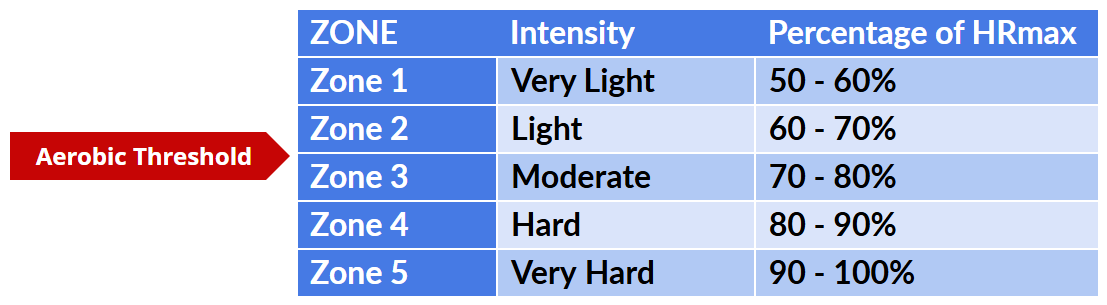
Maximum Heart Rate (MaxHR) is an estimated calculation of the rate at which your body works at its maximum capacity, and knowing it is crucial for developing an effective training schedule. During exercise, the body primarily produces lactate—not lactic acid in significant amounts—as a byproduct of anaerobic metabolism, which is rapidly cleared or used rather than simply accumulating to cause the “burn” or fatigue tied to specific muscle groups under maximal effort, not just heart rate alone. This estimate, combined with other measurements, helps us create your individualized Heart Rate Zone Chart, a tool for planning efficient training, including cardio outside the 80% effort in Zone 2 (Aerobic Threshold) and VO2max interval training for the remaining 20%. For very fit older individuals, MaxHR calculations may become inaccurate, requiring alternative methods, and it also ties critically to VO2max, another key metric not calculated here. Spending 80% of your aerobic time in Zone 2 and 20% in “near-max heart rate” VO2max interval training is the best proven strategy to optimize performance, endurance, and health, as it’s the only way to increase VO2max effectively. Engage with Point1 today to learn how this integrates, build your personalized Heart Rate Zone Chart, and devise an optimal plan tailored to your goals, transforming your overall health, endurance, and performance.
BMI Score (BMI)
For the general population, this score can serve as an initial warning sign of the need for a health and fitness intervention, though it should only be used as a guide. While it effectively identifies individuals who are underweight, overweight, or obese, there are instances where it can be highly inaccurate, particularly for a small segment of the population. This includes true athletes with lower-than-average body fat and high lean muscle mass, who may be incorrectly classified as overweight or obese, or those who are “skinny fat,” where the score labels them as “ideal weight” or underweight without reflecting their true fatness, often concentrated in the midsection with minimal muscle mass. For a precise assessment, an accurate body-fat analysis is essential for all individuals, without exception, as this score alone may not fully capture the nuances of body composition.
Body-Fat Percentage
How fat or lean are you? A complete body composition analysis is needed, with specialized devices. Knowing your accurate body fat percentage is absolutely essential. This allows us to determine a path to your goals and then track along the way, to make certain you are staying on the correct path. A Dexa scan, or second best, an InBody scan is needed. At home/gym devices are extremely inaccurate and should only be considered a novelty. Are you a fat ass, are you skinny fat, or are you an optimized machine? Get the facts, make a plan, and experience the changes. Point1 can perform InBody testing, depending on where you are located geographically. Engage with Point1 to seek testing and analyze your body fat percentage accurately.
Resting Heart Rate (RHR)
Probably one of the single most important metrics to track and improve. You need a device to check and monitor it, it cannot be calculated from a formula. The baseline rate should be the beats per minute (BPM) of your heart, and when at complete rest, your body is not in a recovery stage from previous training/exertion or recently ingesting food. Everyone’s body is slightly different for their ideal rate. However, the more aerobically out of shape/condition you are, as well as genetic considerations, the higher this number will be. Very-well conditioned athletes can expect their baseline to be in the low forties (40’s). Once a baseline is established, for all individuals, a subsequent elevation can signify the need for recovery, over-training, poor sleep, poor nourishment, poor hydration status, stress, age, illness, or the like. It is one of the best metrics to indicate over general fitness level and health, and it is crucial for all to know and track theirs, on a daily basis.
HRV Status
Heart rate variability (HRV) is a measurement and analysis of the time in between your heart beats. It provides fairly accurate insight into the sympathetic and parasympathetic nervous system, and the balance between the two. The time in between an ideal heartbeat should vary slightly; a consistent (constant) time in between beats can be a sign of stress or other factors. Just like RHR, but with more granular accuracy, HRV can give a massive amount of insight into recovery status, over-training, poor sleep, poor nourishment, poor hydration status, stress, age, illness, or the like. HRV is easy to accurately monitor and track with the correct device for your needs. Reach out to Point1 for additional training and insight on HRV, and make it work for you.
VO2max
VO2max Is how many milliliters of oxygen are being used by each kilogram of your body weight, the higher the better. It is directly correlated to the status, efficiency, and conditioning of your heart and lungs, and all of their associated systems. Truly the only way to measure VO2max is a lab test. However, there are certain devices that can assist in guesstimating what yours is at. If you can, it is an important number to know; if it is just not feasible for you to be tested, then just incorporating VO2max training to your regiment is a must. If you are training it properly, is it guaranteed to increase, whether you are accurately measuring or not. Like RHR, VO2max is one of the best metrics to indicate over general fitness level and health. Reach out to Point1 to learn more about this ever import number and how to put together a plan to increase it.
This is an essential number, which allows you to plan properly and engage in Zone 2 training, also known as steady-state training. Zone 2 training should be about approximately 80% of your aerobic training volume. Yes, that is correct, 80%. It is not a glamorous exercise, but hands-down, provides the absolute biggest bang to your improved health, performance, and endurance. The body will optimize its ability to oxidize (burn) fat in Zone 2, yes, lose the most fat. It also has a direct effect on optimizing capillary density, increasing mitochondria, and as a result, benefiting your muscular fitness and overall health and performance. Developing a robust and consistent Zone 2 plan will guarantee a lower resting heart rate, increased aerobic capacity, increased endurance, and overall performance…without question. Don’t wait, engage with Point1 to learn how to make yourself better in everything, with guaranteed results. In the meantime, read the rest of this report to learn more.
Point1 recommends eating a whole-foods diet, for optimal health and nutrition.
Try sticking to only the items contained in the list below, which is based upon the Whole30® shopping list, unless you have dietary restrictions.

Be Smart.
Get Notified of Content.
In the meantime, if you have any specific questions, please reach out to us below.
Thank you for your patience.
CONTACT US
Fill out the form below and submit.
Check your email after submitting to verify that you received a support ticket. Please don't forget to look in your spam/junk folder.
We will never, ever, spam you, sell or share your info with a third-party.
Start.
Your.
Transformation.
Today.
Book your appointment with Point1
Pick Appointment Type
Pick date and time
Fill in Your Details
See You Soon!
You will receive an email with all the details for the appointment. Payment may be required at booking and subject to our Booking Terms and Conditions. Video or just voice, the choice is yours!
* Free Discovery Appt. – Video/Voice
(limited-time & availabilty offer)
